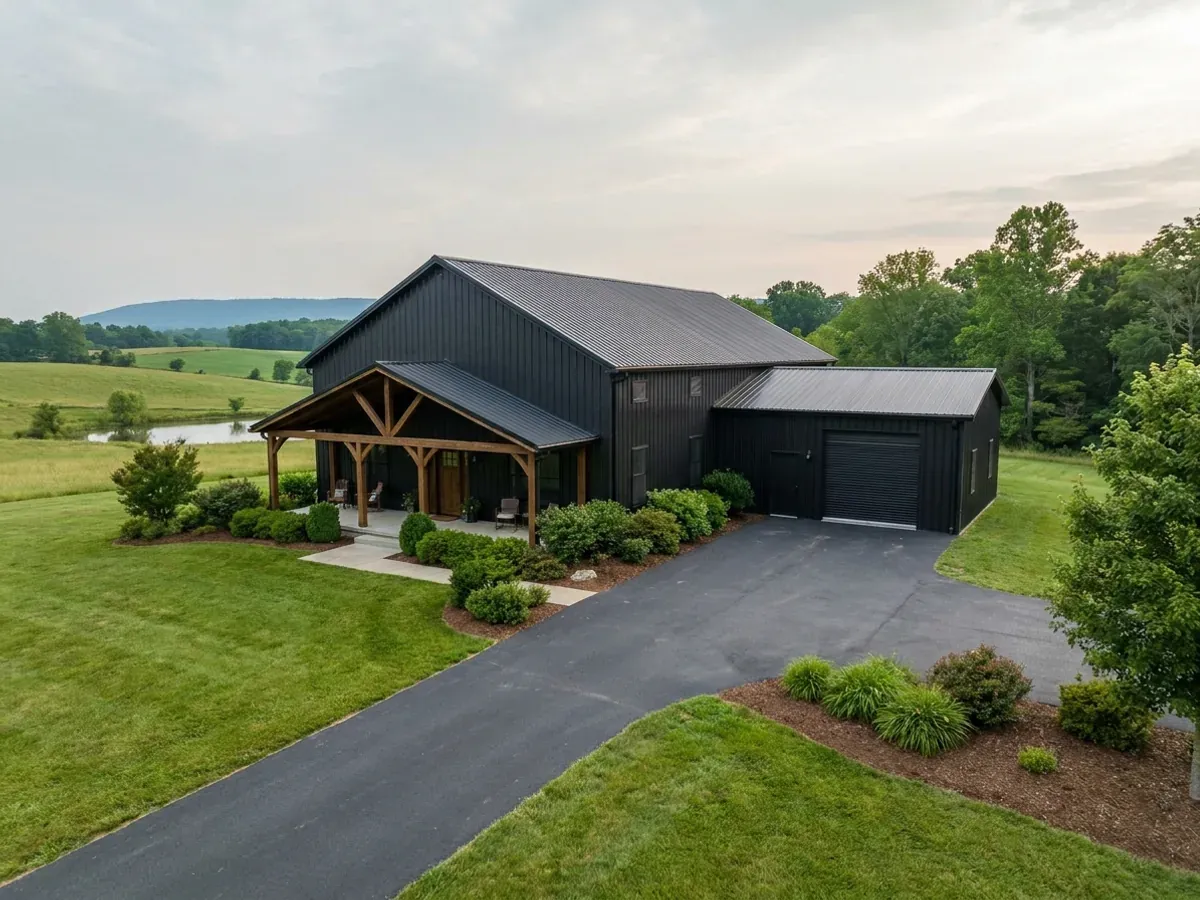
Turnkey Barndominium Builds in Maryland
A turnkey barndominium is built from raw land to a finished home under one contract. We run the whole job in Maryland: site work, foundation, frame, the house finish and the trades, with plumbing, electrical and HVAC by licensed trade contractors, through to the final inspection. You make the decisions that are yours to make, and you have one party answerable for the schedule and for every question the building department asks.
Custom Barndominium Builders, Start to Finish
A custom barndominium builder does more than put up a frame. The job starts with land that is often not ready for a house: no drive, no perc-tested septic site, no well, no power at the building spot. It ends with a finished, inspected home. In between sit a dozen trades and a string of inspections, and on a barndominium they have to work around a frame most house trades see only occasionally.
Turnkey means we carry all of that. We draw or adapt the plan, coordinate the permit set, prepare the site, build the foundation and frame, and finish the house, with licensed trade contractors for plumbing, electrical and HVAC. You choose the layout, the finishes and the budget, and you get one schedule and one contract. The plan is custom to you and your land, not a stock house on a stock lot.
What Turnkey Includes, and What It Does Not
Turnkey covers the building and the work on your land needed to make it a home: clearing and grading for the house and drive, the foundation, the frame and shell, the interior, the automatic fire sprinkler system Maryland requires in new one- and two-family homes, and connection to the septic system, well and power. It also covers coordinating the people we do not employ: the licensed engineer who designs the structure, whoever designs the septic system for the health department, and the well driller.
What it does not include is the land itself, and anything on the land that is yours to decide or the utility's to do, such as the power company's line extension and its charges. We list every inclusion and exclusion in the quote, so the price you see is the price of the home you expect.
Know which route fits? Tell us about the land and we will scope it.
Turnkey Builds: how the work runs
Four stages, in this order. The sequence matters more than it looks: settling what your building department and health department will ask for, and what the land needs, before anything is fabricated is what keeps a Maryland build from stalling.
Land, plan and budget
We start with the land and the money, then the plan: a layout that suits the parcel, the shop you want and the budget. The survey tells us what the land needs before any drawing starts.
Approvals
We coordinate the structural design, the site plan and the permit set, and work through the health department's process for the septic system and the well; in Maryland the building permit cannot be issued until both of those permits are. Construction starts when the approvals are in hand, not before.
Site, foundation and frame
Clearing, the drive, grading, the foundation and the frame go in, and the building is closed in against the weather. The building department inspects the foundation and the frame before anything covers them.
Finish and hand-over
Insulation, the interior, the trades and the finishes, then the final inspections. You get the keys when the building department approves the home for occupancy, along with the warranties and manuals for everything installed.
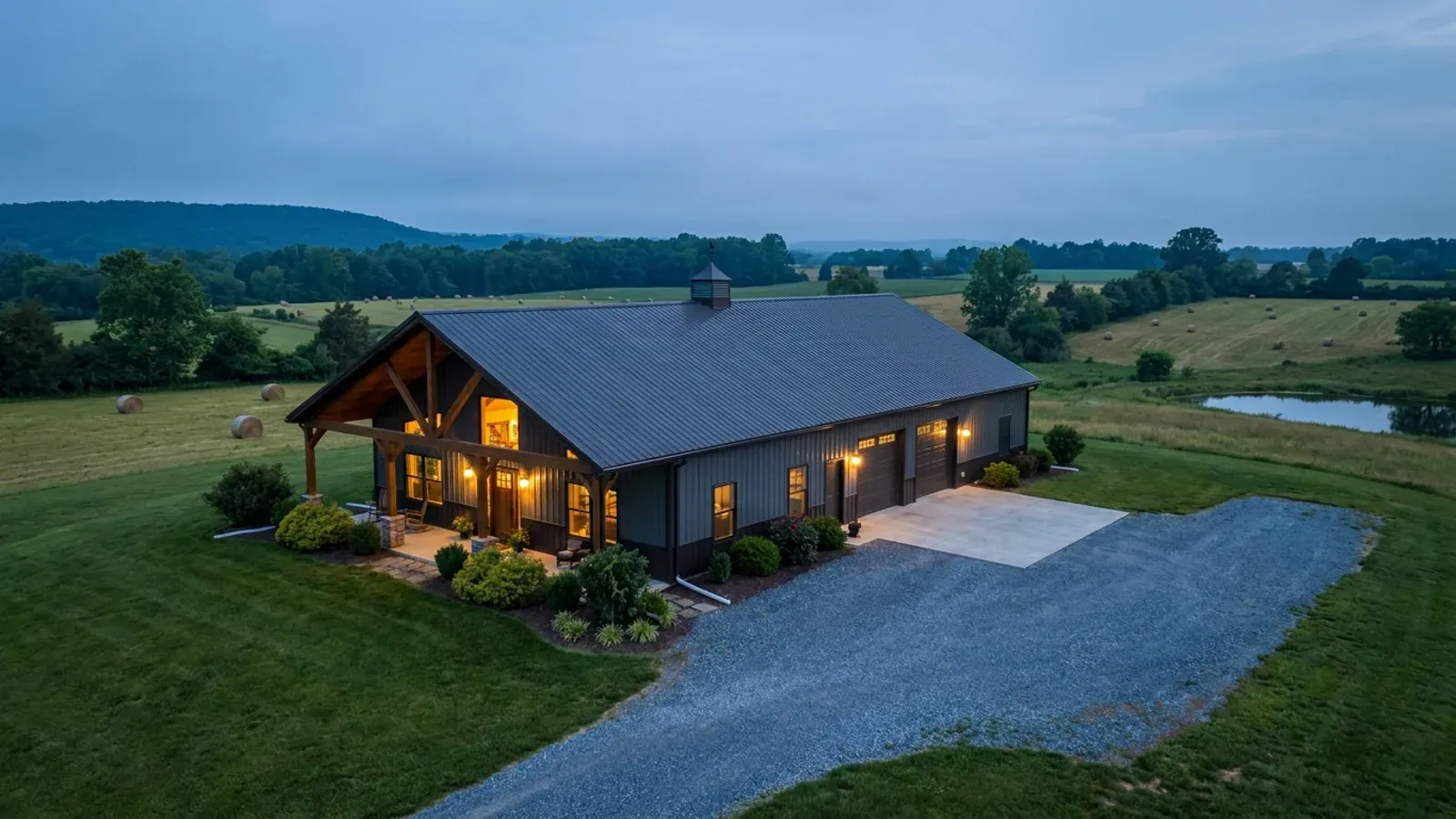
When something goes wrong on a build, the question is who fixes it
On a job split between an owner, a frame erector, a concrete crew and a dozen trades, a missed anchor bolt or a failed inspection becomes a discussion about whose fault it was. On a turnkey build it is ours to fix, and the schedule, the budget and the building department's questions all come back to one party.
Where we deliver turnkey builds
In Maryland the line that matters is usually a county line. The state writes one building code, and local jurisdictions enforce it: in most of the state that is the county, and some towns run their own building departments. Cross that line and what changes is who reviews the drawings, how the land is zoned, what the fees are and which local amendments apply on top of the state code. On land without public sewer and water, the septic and well permits come through the health department, and the building permit waits for both.
Barndominium builders across Maryland.
From Garrett County's mountains to the Lower Eastern Shore, every county has its own answer on permits, septic, wells and land. The service area pages set out what each one publishes.
What actually decides the price
Square footage is the number everyone leads with, and it is rarely the one that moves a barndominium budget. These four do.
-
What the land needs
Clearing, a long drive, grading, septic and well can be a large share of a rural Maryland build, and they vary more from parcel to parcel than the house does. We price them from the land, not from an average.
-
Size and shape
A simple rectangle with a gable roof is the most economical shape. Wings, dormers, porches on every side and complex roof lines add cost faster than square footage.
-
Finish level
Cabinets, counters, flooring, fixtures and trim drive the interior budget, just as in any house. Two identical shells can differ in price by a wide margin once the finishes are chosen.
-
Shop share
A large shop finished simply costs less per square foot than living space. A heated, insulated shop with drains, lifts and tall doors costs more.
Turnkey Builds in Maryland: common questions
8 questions we get asked most often about building in Maryland. If yours is not on the list, ask it directly.
What does turnkey mean for a barndominium?
Do I need to own the land first?
How long does a turnkey barndominium take in Maryland?
Can I do some of the work myself on a turnkey build?
How do I finance a turnkey barndominium?
What is not included in a turnkey price?
Can you build a luxury barndominium?
Is turnkey more expensive than managing the build myself?
Sources
- COMAR 09.12.51.04 (Maryland Building Performance Standards: codes adopted) — Library of Maryland Regulations
- Public Safety Article § 12-505 (local enforcement) — Maryland General Assembly
- 2021 International Residential Code, Chapter 3 Building Planning (R301.1.3, R313.2) — ICC Digital Codes
- COMAR 26.04.02.03 (on-site sewage disposal permits) — Library of Maryland Regulations
Keep reading
The pages that answer the next question this one raises.
Barndominium Financing in Maryland
Construction loans and what a lender wants to see before a turnkey contract.
Read itBarndominium Build Timeline
Land to move-in, stage by stage, and where the waits usually are.
Read itAre Barndominiums Worth It?
An honest look at resale, appraisal and running costs before you commit.
Read itReady to put turnkey builds against a real plan? Start there and the rest follows.
Tell us about the land
Tell us where the parcel is and what you want on it, and we will come back with who reviews the plans, what the land needs before it can be built on, and a realistic budget range. Starting the survey costs nothing.