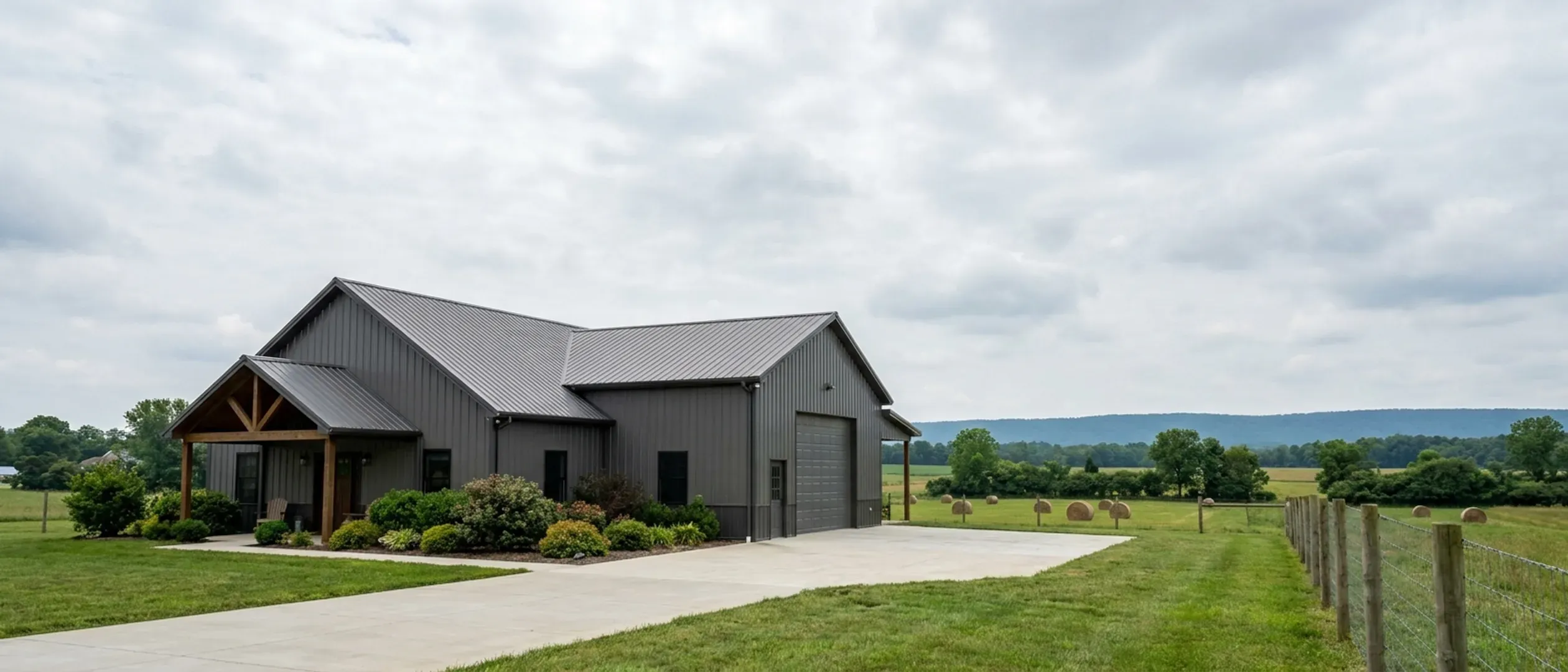
How Much Does It Cost to Build a Barndominium in Maryland?
Nobody publishes a measured average for barndominiums in Maryland, and any page that quotes one is guessing. What does exist is solid public data on new houses built in the region, a national survey that shows where every construction dollar goes, and Maryland's own tax, septic and fee rules. This guide puts those together: the per-square-foot range, what a shell kit leaves out, and the Maryland-specific lines (sales tax on the kit, perc test and septic, the sprinkler system, Critical Area and stormwater work, county fees, and the taxes on buying land) that decide what your build actually costs.
Figures below are industry data from cited third-party sources, not a quote from Maryland Barndominium Builders. Every project is priced individually.
Bottom Line Up Front
- The closest published benchmark is the Census Bureau's 2025 figure for houses a contractor builds on the owner's own land in the South region, which includes Maryland: a median contract price of $157.30 per square foot and an average of $179.96, with the improved lot excluded.
- At those Census figures a 2,000-square-foot home works out to about $315,000 to $360,000, and a 40x60 (2,400 sq ft) to about $378,000 to $432,000, before land, the well, the septic system and most site work.
- The steel or pole barn shell is only part of the bill: in NAHB's 2024 national cost survey, framing plus exterior finishes (roofing, siding, windows and doors) came to 30 percent of construction cost, and interiors plus plumbing, electrical and HVAC came to 43 percent.
- Maryland adds lines a national calculator misses: the 6 percent sales and use tax, a fire sprinkler system in every new one- or two-family home, county perc, septic and well permits, a nitrogen-removing septic unit in the Critical Area, and county recordation and transfer taxes when you buy the land.
Published cost figures
Third-party and government figures, each with its source. None of them is a quote, and none of them is ours.
| Measure | Range | Source |
|---|---|---|
| Contractor-built houses on the owner's land, South region, started in 2025: median to average contract price (improved lot excluded) | $157–$180 per sq ft | U.S. Census Bureau, Characteristics of New Housing 2025, Median and Average Contract Price per Square Foot of New Contractor-Built Single-Family Houses Started: South median $157.30, average $179.96 (read 27 Sep 2026) — https://www.census.gov/construction/chars/xls/contractpricesqft_cust.xls |
| Same houses, all regions of the country, 2025: median to average contract price (improved lot excluded) | $172–$198 per sq ft | U.S. Census Bureau, Characteristics of New Housing 2025, same table: United States median $171.57, average $198.33 (read 27 Sep 2026) — https://www.census.gov/construction/chars/xls/contractpricesqft_cust.xls |
| Average construction cost alone (no lot, overhead, marketing or profit), national builder survey, 2024 | $162 per sq ft | NAHB, Cost of Constructing a Home 2024 (January 2025): average construction cost $428,215, about $162 per square foot; national, no regional breakdown (read 27 Sep 2026) — https://www.nahb.org/-/media/NAHB/news-and-economics/docs/housing-economics-plus/special-studies/2025/special-study-cost-of-constructing-a-home-2024-january-2025.pdf |
| Average construction value on a Maryland single-family building permit, 2025 (9,345 homes) | $294,400 per home | U.S. Census Bureau, Building Permits Survey, annual 2025 by state: Maryland 1-unit 9,345 homes, valuation $2,751,338 thousand; arithmetic $294,418 per home, rounded (read 27 Sep 2026) — https://www.census.gov/construction/bps/xls/stateannual_202599.xls |
| Maryland agricultural land, 2026 state average: pasture to cropland | $8,300–$9,250 per acre | USDA NASS, Land Values 2026 Summary (July 2026): Maryland pasture $8,300, cropland $9,250 per acre; farm real estate $9,950 (read 27 Sep 2026) — https://www.nass.usda.gov/Publications/Todays_Reports/reports/land0726.pdf |
| Home fire sprinkler systems, 2013 national study: average cost per sprinklered square foot | $1.35 per sprinklered ft² | Fire Protection Research Foundation (NFPA), Home Fire Sprinkler Cost Assessment 2013: average $1.35 per sprinklered sq ft across 51 homes in 17 communities, four of them Maryland counties; 2013 dollars (read 27 Sep 2026) — https://www.nfpa.org/education-and-research/research/fire-protection-research-foundation/projects-and-reports/home-fire-sprinkler-cost-assessment-final-report |
Total cost by size
Rough totals at common sizes. These move with everything on this page, so treat them as a starting orientation, not an estimate for your project.
1,500 sq ft
$236,000–$270,000
Arithmetic, rounded to the nearest $1,000: 1,500 sq ft × the Census 2025 South contract price per sq ft for contractor-built houses ($157.30 median, $179.96 average), improved lot excluded — https://www.census.gov/construction/chars/xls/contractpricesqft_cust.xls
2,000 sq ft
$315,000–$360,000
Arithmetic, rounded to the nearest $1,000: 2,000 sq ft × the Census 2025 South contract price per sq ft for contractor-built houses ($157.30 median, $179.96 average), improved lot excluded — https://www.census.gov/construction/chars/xls/contractpricesqft_cust.xls
2,400 sq ft
$378,000–$432,000
Arithmetic, rounded to the nearest $1,000: 2,400 sq ft (a 40x60 footprint) × the Census 2025 South contract price per sq ft for contractor-built houses ($157.30 median, $179.96 average), improved lot excluded — https://www.census.gov/construction/chars/xls/contractpricesqft_cust.xls
3,000 sq ft
$472,000–$540,000
Arithmetic, rounded to the nearest $1,000: 3,000 sq ft × the Census 2025 South contract price per sq ft for contractor-built houses ($157.30 median, $179.96 average), improved lot excluded — https://www.census.gov/construction/chars/xls/contractpricesqft_cust.xls
What actually moves the number
The land, before anything else
USDA's 2026 Land Values survey puts Maryland cropland at $9,250 an acre, pasture at $8,300 and farm real estate at $9,950, against a national farm real estate average of $4,500. Those are state averages for working farmland; a buildable lot with road frontage near Frederick or Annapolis is priced parcel by parcel, and a lot that already has a passing perc test is worth more than one that does not.
Finish level, not the frame
In NAHB's 2024 survey, interior finishes were the largest stage at 24.1 percent of construction cost, followed by plumbing, electrical and HVAC rough-ins at 19.2 percent. Framing was 16.6 percent and exterior finishes 13.4 percent. A steel or pole barn frame changes the smaller slices; cabinets, flooring, bathrooms and mechanical systems cost the same whatever holds the roof up.
Well and septic
Most rural Maryland land has no public water or sewer, so the budget carries a drilled well, a septic system and the county health department's perc test and permits. In the Chesapeake Bay and Atlantic Coastal Bays Critical Area the septic system must be a nitrogen-removing BAT unit, which the state's Bay Restoration Fund can help pay for.
Size and shape
Cost scales with square footage, but not evenly. The well, septic, sprinkler supply, driveway and permits cost roughly the same for a 1,200-square-foot home as for a 2,400-square-foot one, so small homes cost more per square foot. A simple rectangle under one roofline, the classic barndominium form, keeps framing and roofing costs down.
Average cost of a barndominium in Maryland
There is no published average for barndominiums in Maryland. There are three public figures that come close, and together they bracket the answer.
The Census contractor-built figure for the South region
The Census Bureau's contractor-built category is a house a contractor builds on land the owner already has, which is how most barndominiums are built. The Census Bureau groups Maryland in its South region. For houses started in 2025 it reports a South median of $157.30 per square foot and an average of $179.96, and a whole-house South median contract price of $388,100 with an average of $558,400. The improved lot is excluded from all of these.
Maryland building permits
Census building-permit data count 9,345 single-family homes permitted in Maryland in 2025, with a total construction value of $2,751,338 thousand, which works out to about $294,400 per home. Permit values are the construction value declared at permit time, so they run below what owners finally pay, but they are Maryland's own number.
The national NAHB cost survey
NAHB's 2024 survey of builders put the average construction cost of a new home at $428,215, about $162 per square foot, with the lot, overhead and profit counted separately. NAHB notes the sample is not large enough for a regional breakdown, so treat it as the national shape of costs rather than a Maryland price.
Why barndominiums have no price list
Barndominiums are a small share of new homes. Census framing data show steel framing at about 1 percent of contractor-built houses completed in the South in 2025. That is too few homes for any agency to publish a separate barndominium price, which is why honest estimates start from general new-home data and adjust for the finish level you choose.
Shell kit versus turnkey: what each price covers
Most quoted barndominium prices online are for a shell or a kit, not a finished house. NAHB's 2024 cost stages show how much of the house a shell actually covers.
What a kit or shell includes
A steel kit is usually the frame, roof and wall panels, trim and fasteners; a pole barn package is the posts, trusses, girts and metal skin. In NAHB's 2024 national breakdown, framing was 16.6 percent of construction cost and exterior finishes (siding, roofing, windows and doors) 13.4 percent. Together that is about 30 percent of the cost of a finished home. See barndominium kits for what a Maryland kit purchase involves.
What the shell leaves out
The foundation (10.5 percent in NAHB's survey), plumbing, electrical and HVAC rough-ins (19.2 percent), interior finishes (24.1 percent), site work (7.6 percent) and final steps such as the driveway and landscaping (6.5 percent) are all outside a shell price. In Maryland add the sprinkler system, the well and the septic system on top.
Turnkey
A turnkey build carries every stage to a certificate of occupancy. It is the only number you can compare with a conventional house quote. See turnkey builds for how that route works.
Owner-built and partly owner-finished
You can pull the permit yourself as an owner-builder when you build on your own land for your own use; the county will ask you to sign a statement saying so. Doing some interior work yourself saves labor, but lenders, inspectors and the sprinkler requirement do not change.
What a 40x60 barndominium costs, and other common sizes
These are arithmetic on the Census South-region range, not quotes. They cover the house, not the land, well, septic or most site work.
What does a 40x60 barndominium cost?
A 40x60 footprint is 2,400 square feet on one floor. At the Census 2025 South median and average contract prices ($157.30 and $179.96 per square foot) that is about $378,000 to $432,000 for a finished home before land and site work. If part of the 40x60 is an unfinished shop, the finished area and the cost both come down. See the 40x60 floor plan.
What a 2,000 sq ft barndominium costs
At the same Census figures a 2,000-square-foot finished home is about $315,000 to $360,000 before land and site work. That is close to the Census Bureau's 2025 Maryland permit average of about $294,400 per home, which is recorded at permit time before overruns and upgrades.
How Big a Barndominium Can You Build for $100,000 or $200,000?
Divided by the Census South range, $200,000 covers roughly 1,100 to 1,270 finished square feet, and $100,000 roughly 560 to 640, before land, well, septic and site work. Land, the well and the septic system come on top, so a $100,000 budget usually covers less house than the Census arithmetic suggests. The size-for-budget guide works through each budget.
Price per square foot is a range, not a rate
The spread between the Census median and average shows how much finish level matters. A plain interior with a slab floor sits near the median; high ceilings, a large kitchen, a loft and premium finishes push toward the average and beyond.
Maryland costs most national guides leave out
These lines are set by Maryland law or by your county, not by the building. Each is sourced below.
County permit, impact and excise fees
Building permit fees are set by the county to cover plan review and inspections (Public Safety §12-505). Many counties also charge development impact fees or building excise taxes on a new home. The Department of Legislative Services' 2026 taxing-authority guide lists, for example, Baltimore County's residential impact fee at $6 per square foot capped at $30,000, and Dorchester County's power to set a building excise tax of up to $5,000 per residential unit. Ask the county for its current schedule before you budget. NAHB's national survey put average permit fees at $7,640 and impact fees at $6,367 per home in 2024.
Septic in the Critical Area: the BAT unit
New homes in the Chesapeake Bay or Atlantic Coastal Bays Critical Area need a nitrogen-removing (BAT) septic system, maintained every year; outside the Critical Area a conventional system is allowed unless the county requires BAT. MDE's Bay Restoration Fund guidance pays new construction the BAT cost minus $1,200 (its statewide average cost of a conventional tank), in full for households earning up to $300,000 a year and at 50 percent above that. University of Maryland Extension puts the electricity to run an approved BAT unit at $3.24 to $18.86 a month.
Wet-season perc testing
Where the water table rises seasonally, the health department runs the perc test in the wet season, when the water table is highest. Ask your county when its testing season is, because a missed window can push a land purchase or a construction loan back by months.
Labor costs
Maryland construction labor is priced close to the national level. The Bureau of Labor Statistics' May 2025 wage survey puts the mean hourly wage for construction and extraction occupations at $31.34 in Maryland against $31.42 nationally; carpenters were $33.19 against $31.55, electricians $36.28 against $34.37, and plumbers $35.34 against $34.70. Crew availability near the D.C. suburbs and Baltimore matters more to a schedule than the wage rate.
Reading this because you are weighing a build? The next step is a plan drawn for your program.
What's different about Maryland
Sales and use tax on the kit
Maryland's sales and use tax rate is 6 percent (Tax-General §11-104). A steel building package is a large materials purchase, so ask the supplier in writing how tax is charged on your kit and whether it is in the quote; on a $60,000 package the arithmetic at 6 percent is $3,600.
Sprinklers are a required line
New one- and two-family homes in Maryland need an automatic fire sprinkler system; a county can relax this only for a home that is not connected to the electric utility (2021 IRC R313.2; Public Safety §12-504). The Fire Protection Research Foundation's 2013 study, which included Baltimore, Carroll, Montgomery and Prince George's counties, put the average at $1.35 per sprinklered square foot, in 2013 dollars. A home on a well may also need a storage tank or pump to supply the system.
Perc test, septic and well permits come first
Before a county will issue a building permit for a home on septic and a well, the health department must issue the septic permit and the well permit (COMAR 26.04.02.03F). The fees are county fees: Anne Arundel County's health department lists $450 for a perc test on a platted lot, $600 for a complete septic system permit and $630 for a new well permit, and Frederick County's schedule (as of September 2025) lists $160 for a well permit and $200 for a new conventional septic permit.
The Critical Area, forest and stormwater
Land within 1,000 feet of tidal water or tidal wetlands is usually in the Critical Area, with a buffer of at least 100 feet, lot-coverage limits and a required BAT septic unit. Clearing more than 20,000 square feet of forest for your own home brings in a forest conservation plan, and disturbing more than 5,000 square feet of ground needs a county-approved stormwater plan. Each of these can add design and site-work cost, so check the county maps before you buy.
Taxes on buying the land
Buying land brings Maryland's 0.5 percent state transfer tax plus a recordation tax whose rate each county sets (Tax-Property §13-203, §12-103). The Department of Legislative Services lists fiscal 2026 recordation rates from $2.50 per $500 of the price in Baltimore and Howard counties to $7.00 in Charles and Frederick counties, and county transfer taxes from none in five counties to 1.5 percent in Baltimore City and Baltimore County. The reduced first-time-buyer state rate applies to improved residential property, so it does not cover a bare lot. Your title company will quote the total.
What is the average cost to build a barndominium in Maryland?
Is a barndominium cheaper than a regular house in Maryland?
Do I pay sales tax on a barndominium kit in Maryland?
Does a Maryland barndominium need fire sprinklers?
How much does a perc test and septic permit cost in Maryland?
What closing taxes apply when I buy land for a barndominium?
Do counties charge impact fees on a new home in Maryland?
Why do barndominium prices online look so much lower?
Questions answered? Tell us what you want to build and we will put real numbers against it.
Sources
- U.S. Census Bureau — Median and Average Contract Price per Square Foot of New Contractor-Built Single-Family Houses Started (Characteristics of New Housing, 2025) — South 2025: median $157.30, average $179.96 per sq ft; United States $171.57 / $198.33; improved lot excluded. Read 27 Sep 2026.
- U.S. Census Bureau — Median and Average Contract Price of New Contractor-Built Single-Family Houses Started — South 2025: median $388,100, average $558,400. Read 27 Sep 2026.
- U.S. Census Bureau — Type of Framing in New Single-Family Houses Completed — Contractor-built, South 2025: wood 88%, concrete 11%, steel 1%. Read 27 Sep 2026.
- U.S. Census Bureau — Building Permits Survey, New Privately Owned Housing Units Authorized, annual 2025 by state — Maryland 1-unit: 9,345 units, valuation $2,751,338 thousand. Read 27 Sep 2026.
- NAHB — Cost of Constructing a Home 2024 (January 2025) — Average construction cost $428,215 (about $162/sq ft); stage shares; permit fees $7,640, impact fee $6,367. Read 27 Sep 2026.
- USDA National Agricultural Statistics Service — Land Values 2026 Summary (July 2026) — Maryland 2026: farm real estate $9,950, cropland $9,250, pasture $8,300 per acre; U.S. farm real estate $4,500. Read 27 Sep 2026.
- Fire Protection Research Foundation (NFPA) — Home Fire Sprinkler Cost Assessment — 2013 update: average $1.35 per sprinklered sq ft; Maryland communities included. Read 27 Sep 2026.
- Maryland Code, Tax-General §11-104 (sales and use tax rate) — 6 cents for each exact dollar. Read 27 Sep 2026.
- Maryland Code, Tax-Property §13-203 (state transfer tax) — 0.5% of the consideration; 0.25% seller-paid for first-time buyers of improved residential property. Read 27 Sep 2026.
- Maryland Department of Legislative Services — County Revenue Outlook, Fiscal 2026 — Recordation rates $2.50 to $7.00 per $500; local transfer taxes 0.5% to 1.5%, none in five counties. Read 27 Sep 2026.
- Maryland Department of Legislative Services — Guide to Local Government Taxing Authority (August 2026) — County impact fees and building excise taxes; Baltimore County $6/sq ft capped at $30,000; Dorchester excise cap $5,000 per unit. Read 27 Sep 2026.
- Maryland Department of the Environment — Bay Restoration Fund Septic System Upgrade Program guidance — New construction grant = (BAT cost − $1,200) × income eligibility (100% up to $300,000). Read 27 Sep 2026.
- COMAR 26.04.02 (sewage disposal and water supply; BAT, permits before building permit) — BAT for new construction in the Critical Areas; wet-season testing; septic and well permits before the building permit. Read 27 Sep 2026.
- Anne Arundel County Department of Health — Permit Fees — Perc test (platted lot) $450; complete septic system $600; new well $630. Read 27 Sep 2026.
- Frederick County Health Department — Environmental Health Fee Schedule — Well permit $160; new conventional septic permit $200 (fees as of 1 Sep 2025). Read 27 Sep 2026.
- University of Maryland Extension — Septic Systems and Best Available Technologies (FS-1110, September 2020) — Average monthly electric cost of Maryland-approved BAT units $3.24 to $18.86. Read 27 Sep 2026.
- U.S. Bureau of Labor Statistics — Occupational Employment and Wage Statistics, Maryland (May 2025) — Mean hourly wages, Maryland vs. national: construction and extraction $31.34 / $31.42; carpenters $33.19 / $31.55; electricians $36.28 / $34.37; plumbers $35.34 / $34.70. Read 27 Sep 2026 through the BLS Public Data API.
- Maryland Code, Public Safety §12-504 and §12-505 (local amendments; county enforcement and fees) — Counties may not weaken one- and two-family sprinkler provisions; off-grid exception. Read 27 Sep 2026.
Keep reading
The pages that answer the next question this one raises.
Barndominium vs. house cost
The same NAHB cost stages, compared for a steel or pole barn shell and a conventionally framed house.
Read itWhat size can your budget build?
The Census range turned into square footage at $100,000 to $500,000, plus small-footprint options.
Read itBarndominium financing in Maryland
Construction-to-permanent loans, appraisals, the Maryland Mortgage Program and Farm Credit lenders.
Read itBarndominium kits
What a kit covers, and what a Maryland build adds around it.
Read itPole barn homes
The post-frame route and where it fits a Maryland budget.
Read itSite preparation
Clearing, grading, driveway and pad work, which a house price per square foot leaves out.
Read itWant a real number instead of a range?
Start the survey and tell us about your land and what you want to build. Include the county and the tax map and parcel number if you have them, because in Maryland the county, the land-use rules that cover the parcel and the perc, septic and well answers change the budget more than the building does. The survey costs nothing.