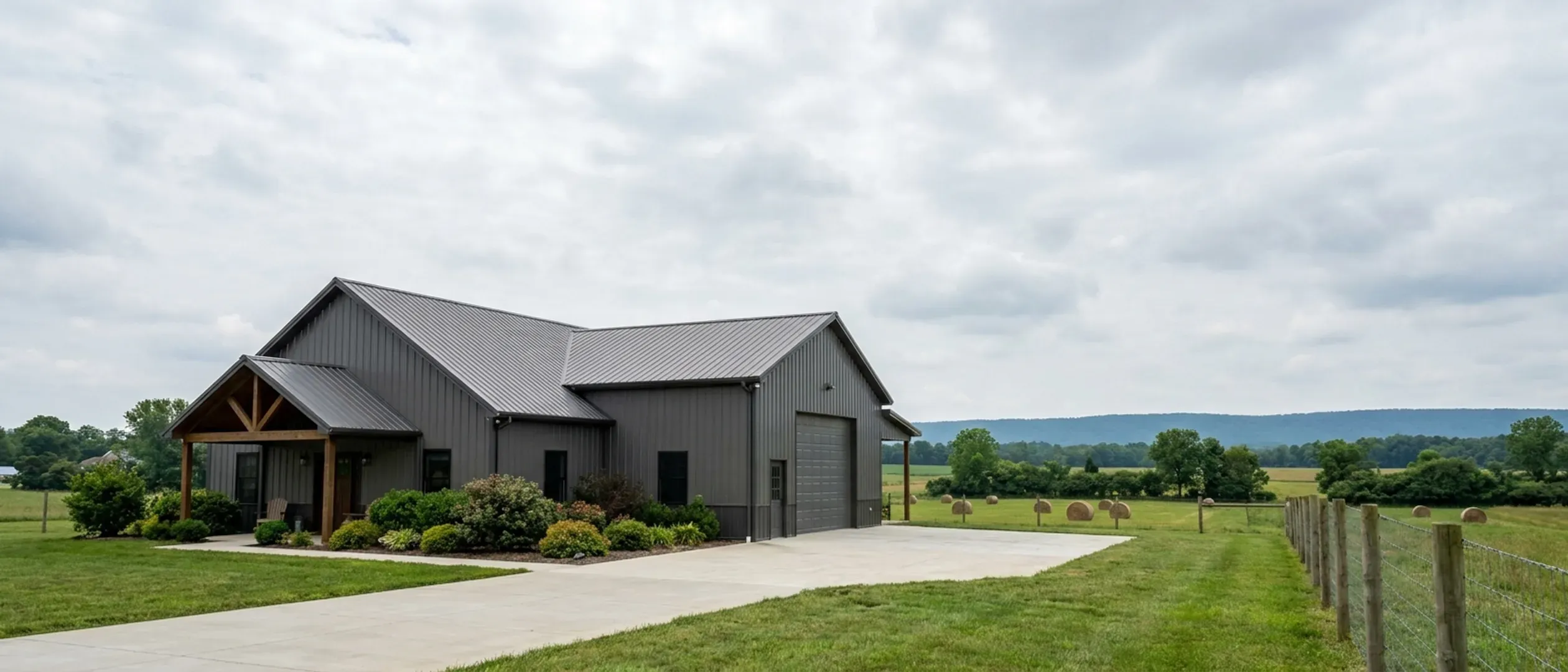
Barndominium Financing in Maryland
A barndominium is financed like any other new house you build on your own land: a construction loan that pays the builder in stages, then a permanent mortgage. The difference is in the details lenders care about. The appraiser has to find comparable sales for an unusual house, a state program may or may not cover a rural lot, and the lenders most at home with acreage are not always the ones advertising on television. This guide sets out each option with its source, and what it means for a Maryland build.
Figures below are industry data from cited third-party sources, not a quote from Maryland Barndominium Builders. Every project is priced individually.
Bottom Line Up Front
- Most owner-built and contractor-built homes are financed with a construction-to-permanent loan; Fannie Mae's rules for the single-closing version allow no single construction period over 12 months, 18 months in total, and a permanent term of up to 30 years.
- The Maryland Mortgage Program does cover new construction, but only in a Priority Funding Area, on a lot of up to 4 acres (exceptions up to 10 for septic or zoning), and it can pay off a construction loan when the house is finished.
- Horizon Farm Credit and Colonial Farm Credit both lend on rural homes and home construction in Maryland; Horizon says you do not have to be a farmer, and Colonial's Hughesville office serves Anne Arundel, Calvert, Charles, Prince George's and St. Mary's counties.
- The Census Bureau reports that 23 percent of contractor-built homes started in the South region in 2025 were paid for in cash; the rest were financed, mostly with conventional loans.
Published cost figures
Third-party and government figures, each with its source. None of them is a quote, and none of them is ours.
| Measure | Range | Source |
|---|---|---|
| Conforming loan limit, one-unit home, 2026: most Maryland counties and Baltimore City | $832,750 per loan | FHFA, Conforming Loan Limits for 2026 (full county list): $832,750 one-unit in every Maryland county except Calvert, Charles, Frederick, Montgomery and Prince George's (read 27 Sep 2026) — https://www.fhfa.gov/document/data/fullcountyloanlimitlist2026_hera-based_final_flat.xlsx |
| Conforming loan limit, one-unit home, 2026: Calvert County, and Charles, Frederick, Montgomery and Prince George's counties | $1,209,750–$1,249,125 per loan | FHFA, Conforming Loan Limits for 2026 (full county list): Calvert $1,209,750; Charles, Frederick, Montgomery and Prince George's $1,249,125 one-unit (read 27 Sep 2026) — https://www.fhfa.gov/document/data/fullcountyloanlimitlist2026_hera-based_final_flat.xlsx |
What actually moves the number
The construction phase
The lender pays the builder in draws as work passes inspection, and you usually pay interest only on what has been drawn. Under Fannie Mae's single-closing rules, no single construction period may run past 12 months and the total may not exceed 18 months, so a realistic schedule matters to the loan as much as to the build.
The appraisal
The loan amount rests on the appraised value of the finished home. Fannie Mae's guide asks the appraiser to find sales with similar physical and legal characteristics and, in a rural area with few sales, allows older sales or a wider market area as long as the report explains why.
The land
Many programs limit acreage or location. The Maryland Mortgage Program caps the lot at 4 acres and requires new construction to be in a Priority Funding Area; Horizon Farm Credit advertises no maximum acreage limitation and Colonial Farm Credit no minimum or maximum.
The rate, and when it is locked
Freddie Mac's weekly survey put the average 30-year fixed rate at 7.03 percent on September 24, 2026, and the 15-year at 6.42 percent. Ask whether your construction-to-permanent rate is locked at closing or set when the loan converts.
Construction-to-permanent loans
This is the standard way to finance a barndominium you are building on land you own or are buying.
Single closing or two closings
A single-closing loan covers construction and the permanent mortgage in one set of documents; a two-closing route uses a separate construction loan that a new mortgage pays off at the end. Fannie Mae's single-closing rules require the construction phase to be a temporary loan, cap any single construction period at 12 months and the total at 18, and allow a permanent term of up to 30 years after conversion.
The lender manages the draws
In a single-closing transaction the lender is responsible for paying out the loan to the builder, contractor or suppliers. Expect a draw schedule tied to stages (foundation, dry-in, rough-ins, finishes) and an inspection before each draw. Maryland's Custom Home Protection Act adds its own rules: your builder must hold advance payments above 5 percent of the price in escrow (unless a bank finances the job) and give you a written contract with a separately signed draw schedule.
Owner-builders
You can pull the permit yourself as an owner-builder when you build on your own land for your own use; the county will ask you to sign a statement saying so. Ask each construction lender whether it lends to owner-builders, and what experience or contractor oversight it requires, before you commit to that route.
Kit deposits
If a kit supplier asks for a deposit before fabrication, it may fall before your loan's first draw. Ask the lender whether a kit deposit can be reimbursed at closing or counted toward your down payment.
How barndominiums are appraised
The appraisal decides how much a lender will lend. Barndominiums are few, so the comparable sales take work.
Comparable does not mean identical
Fannie Mae's Selling Guide (B4-1.3-08) says comparable sales should have similar physical and legal characteristics, including site, room count, finished area, style and condition, and that comparables need not be identical to the subject property but should appeal to the same buyers. A barndominium is usually compared with other homes of similar size, acreage and finish in the area.
Rural sales and older comps
The same guide lets the appraiser use sales older than 12 months if the property is in a rural area with minimal sales activity, and look beyond the immediate market area, provided the report explains why. That is the normal situation for a barndominium on acreage in Garrett, Kent or Somerset County.
What helps the appraisal
Give the appraiser a complete plan set and finish schedule, the square footage split between living space and shop, and any recent local sales of metal-sided or post-frame homes you know of. Ask the appraiser how the living area and any unfinished shop space will each be treated in the report.
The shop is not free square footage
Lenders lend on appraised value, not on cost. If a large attached shop adds less to the appraised value than it costs to build, the difference comes out of your down payment, so plan the shop's size with that in mind. See shouses for how shop-house layouts are planned.
USDA rural loans in Maryland
USDA Rural Development guarantees and makes home loans in eligible rural areas.
Two tests: the place and the household
USDA's eligibility site says that for many USDA loans household income must meet certain guidelines, and the home must be located in an eligible rural area as defined by USDA. Both are checked by address and household size on USDA's property and income eligibility site.
Check the parcel, not the county
Eligibility is mapped by area, not by county, so two parcels in the same Maryland county can fall on different sides of the line. Enter the exact address or parcel location on the USDA map before you plan around a USDA loan.
Ask about construction
Ask a USDA-approved lender directly whether it makes single-close construction loans under the USDA guarantee, and what it requires of the builder and the plans.
Farm Credit lenders that serve Maryland
Farm Credit associations are cooperatives owned by their member-borrowers that finance rural land and homes. The Farm Credit network's Maryland page lists the associations that lend in the state.
Horizon Farm Credit
Horizon Farm Credit has Maryland offices in Bel Air, Chestertown, Denton, Frederick, Salisbury and Westminster. Its rural home loan page offers construction loans and land loans, says you do not have to be a farmer to use its financing, lists no maximum acreage limitation, and advertises up to 85 percent financing with no mortgage insurance for first-time rural property owners (with conditions marked on the page).
Colonial Farm Credit
Colonial Farm Credit serves rural southern Maryland from its Hughesville office, which lists Anne Arundel, Calvert, Charles, Prince George's and St. Mary's counties. Its home loan page offers home construction financing, including barns and outbuildings, and lists no minimum or maximum acreage limitation.
Western Maryland
For Garrett County, Allegany County and Washington County, use the Farm Credit network's Maryland page to find the association that lends where your land is; the network lists more than one association for the state.
Why acreage lenders matter for barndominiums
Barndominiums are often built on more land than a standard program allows: the Maryland Mortgage Program's lot limit is 4 acres. Both Farm Credit associations above publish home loan terms with no maximum acreage, which is why they are worth a call for a build on a larger parcel.
Reading this because you are weighing a build? The next step is a plan drawn for your program.
What's different about Maryland
The Maryland Mortgage Program covers new construction, with conditions
The Maryland Mortgage Program, run by the Community Development Administration, lets eligible buyers build or buy a new home (built within the last 12 months) only if it is in a Priority Funding Area: every municipality as it existed in 1997, the areas inside the two Beltways around Baltimore and the District of Columbia, and designated enterprise zones, revitalization areas, heritage areas and existing industrial land. Most farmland outside towns is not in one, so check the parcel on the program's mapper before you plan around it.
Lot size and lot ownership rules
The program's lot limit is 4 acres, with exceptions up to 10 acres where septic or zoning rules require a larger parcel. A lot you have owned for two years or less can be financed up to the payoff of the lot loan and closing costs; a lot owned longer cannot be mortgaged through the program, and the home qualifies only if that lot is owned free and clear.
It can take out your construction loan
Program loan proceeds may not refinance an existing mortgage, with named exceptions that include a construction loan or bridge loan used as temporary initial financing. In practice that makes it a possible permanent loan at the end of a build, arranged through one of the program's approved lenders.
Conforming loan limits differ by county
FHFA's 2026 one-unit conforming limit is $832,750 in most of Maryland, $1,209,750 in Calvert County and $1,249,125 in Charles, Frederick, Montgomery and Prince George's counties. A loan above the limit for your county is a jumbo loan, with its own down-payment and reserve rules.
Registered builders and your lender
In Maryland, anyone who builds, or offers to build, a new home for someone else must be registered with the Attorney General's Home Builder Registration Unit, and a contract with an unregistered new-home builder is not enforceable under Maryland law. Ask for the builder's registration number and check it before you sign, and before your lender funds the first draw.
Can you get a mortgage for a barndominium in Maryland?
Does the Maryland Mortgage Program cover new construction?
How long can a construction-to-permanent loan run?
Can I use a USDA loan for a barndominium in Maryland?
How do appraisers value a barndominium with no barndominium sales nearby?
What are mortgage rates for a barndominium today?
What is the conforming loan limit in Maryland in 2026?
Do most people pay cash for a custom-built home?
Questions answered? Tell us what you want to build and we will put real numbers against it.
Sources
- Fannie Mae Selling Guide — B5-3.1-02, Conversion of Construction-to-Permanent Financing: Single-Closing Transactions (05/06/2026) — No single construction period over 12 months, total 18; term up to 30 years after conversion; lender manages disbursement. Read 27 Sep 2026.
- Fannie Mae Selling Guide — B4-1.3-08, Comparable Sales (06/04/2025) — Similar physical and legal characteristics; older sales in rural areas with minimal activity if explained. Read 27 Sep 2026.
- Maryland Mortgage Program — Loan Eligibility — New construction (built within the last 12 months) must be in a Priority Funding Area. Read 27 Sep 2026.
- Maryland Mortgage Program — Compliance Manual (updated January 28, 2026) — §2.10 new construction in PFA only; 4-acre lot limit, exceptions to 10; lot owned two years or less; §2.11 construction-loan refinance allowed. Read 27 Sep 2026.
- USDA Rural Development — Income and Property Eligibility Site — Household income guidelines and eligible rural areas, checked by address. Read 27 Sep 2026.
- Farm Credit — Maryland — Farm Credit institutions lending in Maryland, including Colonial Farm Credit and Horizon Farm Credit. Read 27 Sep 2026.
- Horizon Farm Credit — Rural Home Loans — Construction and land loans; not limited to farmers; no maximum acreage; up to 85% financing for first-time rural property owners (conditions apply). Read 27 Sep 2026.
- Horizon Farm Credit — Maryland offices — Bel Air, Chestertown, Denton, Frederick, Salisbury and Westminster offices. Read 27 Sep 2026.
- Colonial Farm Credit — Hughesville Office — Counties served: Anne Arundel, Calvert, Charles, Prince George's, St. Mary's. Read 27 Sep 2026.
- Colonial Farm Credit — Home Loans — Home construction financing; no minimum or maximum acreage limitation. Read 27 Sep 2026.
- FHFA — Conforming Loan Limits for 2026, full county list — Maryland one-unit limits: $832,750; Calvert $1,209,750; Charles, Frederick, Montgomery, Prince George's $1,249,125. Read 27 Sep 2026.
- Freddie Mac — Primary Mortgage Market Survey, historical data — Week of September 24, 2026: 30-year fixed 7.03%, 15-year fixed 6.42%. Read 27 Sep 2026.
- U.S. Census Bureau — Contractor-Built Houses Started by Type of Financing — South 2025: conventional 73%, cash 23%, FHA-insured and VA-guaranteed 2% each. Read 27 Sep 2026.
- Maryland Code, Business Regulation §4.5-301 and §4.5-605 (home builder registration) — Registration to act as a home builder; unregistered contracts unenforceable. Read 27 Sep 2026.
- Maryland Code, Real Property §10-504 and §10-505 (Custom Home Protection Act) — Escrow of advance payments above 5%; written contract with a separately signed draw schedule. Read 27 Sep 2026.
Keep reading
The pages that answer the next question this one raises.
How much a barndominium costs in Maryland
The per-square-foot range and the Maryland cost lines a loan has to cover.
Read itWhat size can your budget build?
Turn a loan amount into square footage using the same Census figures.
Read itBarndominium build timeline
The schedule a construction loan's 12- and 18-month limits have to fit.
Read itTurnkey builds
One contract to a certificate of occupancy, the file lenders find easiest to underwrite.
Read itBarndominium kits
Kit deposits and delivery timing, and how they meet a construction loan's draws.
Read itWant a real number instead of a range?
Start the survey and tell us about your land and what you want to build. Include the county and the tax map and parcel number if you have them, because in Maryland the county, the land-use rules that cover the parcel and the perc, septic and well answers change the budget more than the building does. The survey costs nothing.